MI Cancer Seek® is the first and only simultaneous Whole Exome Sequencing (WES) and Whole Transcriptome Sequencing (WTS)-based assay with FDA-approved CDx indications for molecular profiling of solid tumors. MI Cancer Seek is available for adult and pediatric (ages 1-22) patients.
FDA-Approved CDx Indications and Tumor Profiling
MI Cancer Seek is a next-generation sequencing (NGS) based in vitro diagnostic device using total nucleic acid (TNA) isolated from formalin-fixed paraffin embedded (FFPE) tumor tissue specimens for the detection of SNVs, InDels, MSI, TMB in patients with previously diagnosed solid tumors, and CNA in one gene in patients with breast cancer. MI Cancer Seek is intended as a companion diagnostic to identify patients who may benefit from treatment with the targeted therapies listed in the Companion Diagnostic Indications table, in accordance with the approved therapeutic product labeling.
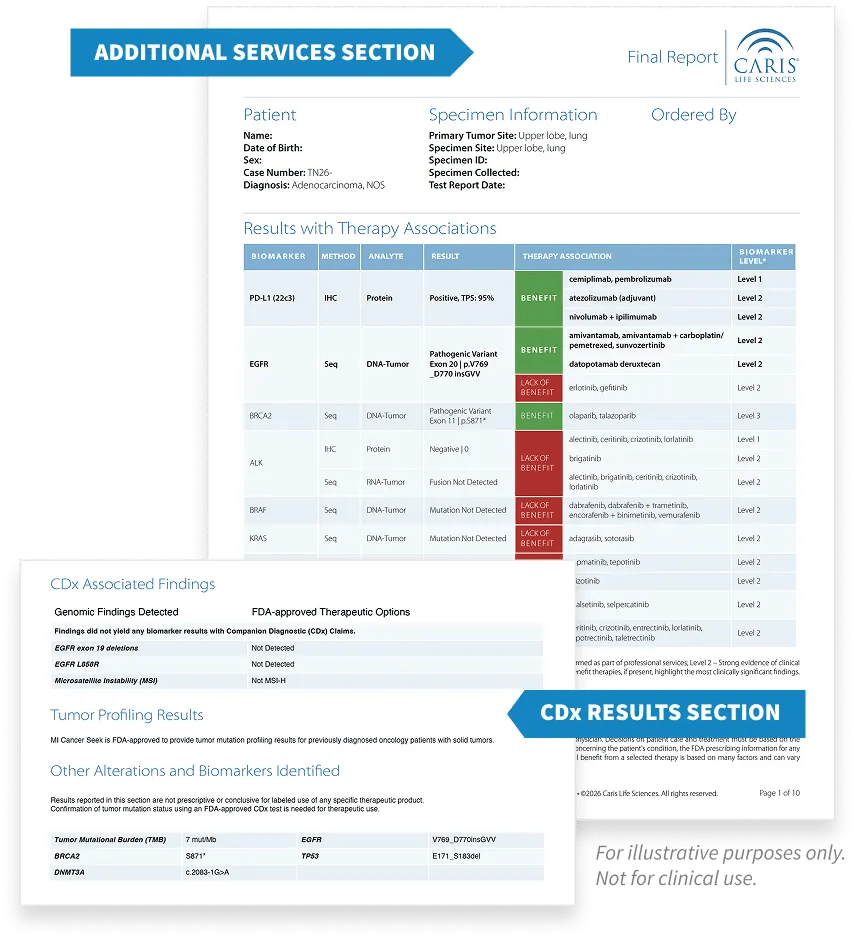
Additional Services
Beyond the MI Cancer Seek FDA-approved indications, additional sequencing-based features are reported.
MI Cancer Seek® is the first and only simultaneous Whole Exome Sequencing (WES) and Whole Transcriptome Sequencing (WTS)-based assay with FDA-approved CDx indications for molecular profiling of solid tumors. MI Cancer Seek is available for adult and pediatric (ages 1-22) patients.
FDA-Approved CDx Indications and Tumor Profiling
MI Cancer Seek is a next-generation sequencing (NGS) based in vitro diagnostic device using total nucleic acid (TNA) isolated from formalin-fixed paraffin embedded (FFPE) tumor tissue specimens for the detection of SNVs, InDels, MSI, TMB in patients with previously diagnosed solid tumors, and CNA in one gene in patients with breast cancer. MI Cancer Seek is intended as a companion diagnostic to identify patients who may benefit from treatment with the targeted therapies listed in the Companion Diagnostic Indications table, in accordance with the approved therapeutic product labeling.
Additional Services
Beyond the MI Cancer Seek FDA-approved indications, additional sequencing-based features are reported.
KEYTRUDA® (pembrolizumab) in combination with LENVIMA® (lenvatinib)
*For the most current information about the device indications for the therapeutic products in this group, go to: https://www.fda.gov/medical-devices/in-vitro-diagnostics/list-cleared-or-approved-companion-diagnostic-devices-in-vitro-and-imaging-tools#Group_Labeling
PIQRAY® is a registered trademark of Novartis AG. VECTIBIX® is a registered trademark of Immunex Corporation. BRAFTOVI® is a registered trademark of Array BioPharma Inc. in the United States and various other countries. ERBITUX® is a registered trademark of ImClone LLC, a wholly owned subsidiary of Eli Lilly and Company. MEKINIST® is a registered trademark of Novartis AG Corporation Switzerland. KEYTRUDA® is a registered trademark of Merck. JEMPERLI® (dostarlimab-gxly) is a registered trademark owned by the GSK group of companies. LENVIMA® (lenvatinib) is a registered trademark used by Eisai Inc. under license from Eisai R&D Management Co., Ltd.
MI Cancer Seek – Technical Specifications and Performance
EGFR exon 19 deletions and exon 21 L858R alterations
PPA: 98.1% NPA: 99.4%
Solid Tumors
MSI-H
PPA: 97.5% NPA: 98.5%
Endometrial
Not MSI-H
PPA: 98.4% NPA: 97.6%
†TNA extraction with ≥50 ng of DNA is the minimum assay input requirement to perform MI Cancer Seek®. If insufficient quantity is submitted (<50 ng), the order for MI Cancer Seek will automatically reflex to MI Tumor Seek Hybrid™ (LDT).
MI Cancer Seek – Technical Specifications and Performance
EGFR exon 19 deletions and exon 21 L858R alterations
PPA: 98.1% NPA: 99.4%
Solid Tumors
MSI-H
PPA: 97.5% NPA: 98.5%
Endometrial
Not MSI-H
PPA: 98.4% NPA: 97.6%
†TNA extraction with ≥50 ng of DNA is the minimum assay input requirement to perform MI Cancer Seek™. If insufficient quantity is submitted (<50 ng), the order for MI Cancer Seek will automatically reflex to MI Tumor Seek Hybrid™ (LDT).
Email the completed form(s) to CustomerSupport@CarisLS.com, or fax to 1.866.479.4925. When specimen is being prepared for shipment, please include completed forms with the shipper.
Tour Our Tissue Lab
Intended Use
MI Cancer Seek is a next-generation sequencing (NGS) based in vitro diagnostic (IVD) device using total nucleic acid (TNA) isolated from formalin-fixed paraffin-embedded (FFPE) tumor tissue specimens for the detection of single nucleotide variants (SNVs) and insertions and deletions (indels) in 228 genes, microsatellite instability (MSI), tumor mutational burden (TMB) in patients with previously diagnosed solid tumors, and copy number amplification (CNA) in one gene in patients with breast cancer.
MI Cancer Seek is intended as a companion diagnostic to identify patients who may benefit from treatment with the targeted therapies listed in the Companion Diagnostic Indications table, in accordance with the approved therapeutic product labeling.
Additionally, MI Cancer Seek is intended to provide tumor mutational profiling to be used by qualified healthcare professionals in accordance with professional oncology guidelines for cancer patients with previously diagnosed solid malignant neoplasms. Genomic findings other than those listed in the Companion Diagnostic Indications table are not prescriptive or conclusive for labeled use of any specific therapeutic product.
Enhance Molecular Insights with Additional Services
MI Cancer Seek is a single assay that analyzes total nucleic acids for both DNA and RNA. Typically, DNA and RNA analysis by NGS requires two separate testing processes, which may require more tissue and more time. By combining WES and WTS into one assay, however, MI Cancer Seek provides a comprehensive molecular blueprint that saves tissue without compromising results.
Caris+Portal
Convenient Access to Caris Profiling
Caris+™Portal provides easy access for users to electronically submit orders, track case progress, view results and review Caris Life Sciences’ profiling information in one convenient location.
New users will select the Register link at the bottom of the login page and enter their name and their clinic or institution email address to verify the account.
Caris+Portal increases accessibility for physicians and clinical staff to simplify ordering, improve order accuracy and efficiency, and quickly access results.
New tests can be easily ordered from any page in the Portal by selecting Create a Requisition at the top of the dashboard.
Caris+Portal
Convenient Access to Caris Profiling
Caris+™Portal provides easy access for users to electronically submit orders, track case progress, view results and review Caris Life Sciences’ profiling information in one convenient location.
New users will select the Register link at the bottom of the login page and enter their name and their clinic or institution email address to verify the account.
Caris+Portal increases accessibility for physicians and clinical staff to simplify ordering, improve order accuracy and efficiency, and quickly access results.
New tests can be easily ordered from any page in the Portal by selecting Create a Requisition at the top of the dashboard.
Easy-to-Interpret Results for Clarity in Treatment Planning
Treatment Planning:
Navigate among FDA-approved drugs and therapies with potential benefit or lack of benefit
Identify therapies that may not have been considered
Match patient to clinical trials based on tumor biology
Evidence-guided:
Drug associations based on peer-reviewed literature and clinical treatment guidelines
Testing methodologies consistent with industry guidelines
EHR Compatible:
Real-time sync
HITECH compliant
Easy installation
Secure encryption
Technical Information
For complete product information, including companion diagnostic indications and performance characteristics, view the Technical Information document.
For in vitro diagnostic use.
CAUTION: Federal law restricts this device to sale by or on the order of a physician.
The acceptable preparation method for MI Cancer Seek CDx specimens is FFPE. Other preparations have not been evaluated.
The test is designed to report out somatic variants and is not intended to report germline variants.
MI Cancer Seek requires a minimum tumor percentage of 20% for detection of alterations, with tumor content enrichment recommended for specimens with tumor percentage lower than 20%.
Genomic findings other than those listed in the Companion Diagnostic Indications table are not prescriptive or conclusive for labeled use of any specific therapeutic product. Confirmation of tumor mutation status using an FDA-approved CDx test is needed for therapeutic use.
A negative result does not rule out the presence of a mutation below the limits of detection of the assay.
MI Cancer Seek is only approved for use with Caris Life Sciences pre-qualified Illumina NovaSeq 6000 instruments.
The test is intended to be performed on specific serial number-controlled instruments by Caris Life Sciences.
MI Cancer Seek does not report TMB for values lower than 3mut/Mb as the accuracy of TMB values are unreliable.
Decisions on patient care and treatment must be based on the independent medical judgment of the treating physician, taking into consideration all applicable information concerning the patient’s condition, such as patient and family history, physical examinations, information from other diagnostic tests, and patient preferences, in accordance with the standard of care in a given community.
Based on the low positive percent agreement (PPA) in the accuracy study for ERBB2 copy number amplifications (CNAs) in breast cancer patients, this alteration may not be detected. Additional clinical investigation to confirm the presence of ERBB2 CNAs in the breast cancer patient’s tumor with another FDA approved or cleared test is strongly recommended.
Patients with breast cancer whose specimens have intermediate ERBB2 CNA status should be tested with another FDA approved or cleared test to ascertain ERBB2 CNA status in their tumor.
Test may have reduced sensitivity and may yield false negative results in samples where necrotic tissue is >15%, melanin is >5%, fat cells are >10%.
FDA Evidence Levels
Genomic findings other than those listed in the Intended Use are not prescriptive or conclusive for labeled use of any specific therapeutic product. Test results should be interpreted in the context of pathological evaluation of tumors, treatment history, clinical findings, and other laboratory data.
Classification Criteria for FDA Evidence Levels
Pre-clinical and/or in vitro studies provide structural analysis of the mutation, fusion, or isoform to confirm pathogenicity (tumor-promoting), sensitivity, or resistance through colony forming assays, growth inhibition or drug sensitivity assays, etc.
Level 1: Biomarker is FDA-approved as a companion diagnostic as part of MI Cancer Seek
Level 2: Cancer alterations that are well-established with strong clinical evidence that the clinician must know according to professional consensus guidelines in the specific tumor type.
Level 3: Cancer alterations with potential clinical significance, e.g., biomarkers deemed useful for directing patients to a clinical trial or simply for informational purposes.
Clinical data such as case reports, single or several case series, or Phase I/II clinical trial data that support the utility of specific biomarker alteration to direct a patient to clinical trials, or
Pre-clinical and/or in vitro studies provide structural analysis of the mutation, fusion, or isoform to confirm pathogenicity (tumor-promoting), sensitivity, or resistance through colony forming assays, growth inhibition or drug sensitivity assays, etc.
There are no known contraindications.
Biopsy may pose a risk to the patient when archival tissue is not available for use with the assay. The patient’s physician should determine whether the patient is a candidate for biopsy.
Specimen Requirements for Next-Generation Sequencing
TEST
SPECIMEN REQUIREMENTS
MI Cancer Seek (CDx)
20% tumor nuclei with ≥25mm2 total tissue area, TNA extraction with ≥50 ng of DNA, Formalin-based fixatives only, Non-decalcified tissue only.
MI Tumor Seek Hybrid (LDT)
20% tumor nuclei, TNA extraction with ≥25-49 ng of DNA, Formalin-based fixatives preferred, Non-decalcified tissue preferred.
MI Cancer Seek (CDx)
SPECIMEN REQUIREMENTS
20% tumor nuclei with ≥25mm2 total tissue area, TNA extraction with ≥50 ng of DNA, Formalin-based fixatives only, Non-decalcified tissue only.
MI Tumor Seek Hybrid (LDT)
SPECIMEN REQUIREMENTS
20% tumor nuclei, TNA extraction with ≥25-49 ng of DNA, Formalin-based fixatives preferred, Non-decalcified tissue preferred.
Formalin Fixed Paraffin Embedded (FFPE) Samples
SPECIMEN TYPE
SPECIMEN REQUIREMENTS
Fixed Tissue
One (1) tumor-containing formalin fixed paraffin embedded block (FFPE) from most recent surgery or biopsy. Successive four (4) micron sections will be created from the block until sufficient material for the testing orders is obtained. For the molecular analysis, tumor cells will be excised by microdissection.
Unstained Slides
Unstained, positively charged, unbaked slides from one single, tumor-containing formalin fixed paraffin embedded block; 4 micron sections. • MI Cancer Seek (CDx): 10 slides (freshly cut, no more than 30 days old) • MI Cancer Seek (CDx) + IHCs: 25 slides (freshly cut, no more than 30 days old) • MI Tumor Seek Hybrid (LDT): 10 slides Note: Specimens with a smaller tumor area may require additional specimen to be submitted.
Core Needle Biopsy
Four to six (4-6) biopsies with 18 gauge needle preferred. Six to ten (6-10) biopsies with 22 gauge needle accepted. (Preparation in 10% neutral buffered formalin.)
Fine Needle Aspirate (FNA)
One (1) formalin fixed paraffin embedded block containing sufficient tumor. Please do NOT use non-formalin-based fixatives, including alcohol-based fixatives.
Malignant Fluid Cell Block
One (1) formalin fixed paraffin embedded cell block containing sufficient tumor (≥20% tumor nuclei). Please do NOT use non-formalin-based fixatives, including alcohol-based fixatives.
Bone/Bone Metastasis
One (1) formalin fixed paraffin embedded block of tumor (primary bone malignancy or metastasis to the bone) decalcified using EDTA based method(s) or non-decalcified specimen.
Fixed Tissue
SPECIMEN REQUIREMENTS
One (1) tumor-containing formalin fixed paraffin embedded block (FFPE) from most recent surgery or biopsy. Successive four (4) micron sections will be created from the block until sufficient material for the testing orders is obtained. For the molecular analysis, tumor cells will be excised by microdissection.
Unstained Slides
SPECIMEN REQUIREMENTS
Unstained, positively charged, unbaked slides from one single, tumor-containing formalin fixed paraffin embedded block; 4 micron sections. • MI Cancer Seek (CDx): 10 slides (freshly cut, no more than 30 days old) • MI Cancer Seek (CDx) + IHCs: 25 slides (freshly cut, no more than 30 days old) • MI Tumor Seek Hybrid (LDT): 10 slides Note: Specimens with a smaller tumor area may require additional specimen to be submitted.
Core Needle Biopsy
SPECIMEN REQUIREMENTS
Four to six (4-6) biopsies with 18 gauge needle preferred. Six to ten (6-10) biopsies with 22 gauge needle accepted. (Preparation in 10% neutral buffered formalin.)
Fine Needle Aspirate (FNA)
SPECIMEN REQUIREMENTS
One (1) formalin fixed paraffin embedded block containing sufficient tumor. Please do NOT use non-formalin-based fixatives, including alcohol-based fixatives.
Malignant Fluid Cell Block
SPECIMEN REQUIREMENTS
One (1) formalin fixed paraffin embedded cell block containing sufficient tumor (≥20% tumor nuclei). Please do NOT use non-formalin-based fixatives, including alcohol-based fixatives.
Bone/Bone Metastasis
SPECIMEN REQUIREMENTS
One (1) formalin fixed paraffin embedded block of tumor (primary bone malignancy or metastasis to the bone) decalcified using EDTA based method(s) or non-decalcified specimen.
Fresh Samples
(All fresh samples should be shipped overnight to be received within 48 hours.)
SPECIMEN TYPE
SPECIMEN REQUIREMENTS
Fresh Tissue
Two (2) or more samples with a maximum thickness of 3-4mm (height, width, length) and submit in 10% neutral buffered formalin.
Core Needle Biopsy
Biopsy Four to six (4-6) biopsies with 18 gauge needle preferred. Six to ten (6-10) biopsies with 22 gauge needle accepted. Place in 10% neutral buffered formalin.
Bone/Bone Metastasis
Two (2) or more samples with maximum thickness of 3-4mm (height, width, length) and submit in 10% neutral buffered formalin (DO NOT DECALCIFY).
Fresh Tissue
SPECIMEN REQUIREMENTS
Two (2) or more samples with a maximum thickness of 3-4mm (height, width, length) and submit in 10% neutral buffered formalin.
Core Needle Biopsy
SPECIMEN REQUIREMENTS
Biopsy Four to six (4-6) biopsies with 18 gauge needle preferred. Six to ten (6-10) biopsies with 22 gauge needle accepted. Place in 10% neutral buffered formalin.
Bone/Bone Metastasis
SPECIMEN REQUIREMENTS
Two (2) or more samples with maximum thickness of 3-4mm (height, width, length) and submit in 10% neutral buffered formalin (DO NOT DECALCIFY).
For in vitro diagnostic use.
CAUTION: Federal law restricts this device to sale by or on the order of a physician.
The acceptable preparation method for MI Cancer Seek CDx specimens is FFPE. Other preparations have not been evaluated.
The test is designed to report out somatic variants and is not intended to report germline variants.
MI Cancer Seek requires a minimum tumor percentage of 20% for detection of alterations, with tumor content enrichment recommended for specimens with tumor percentage lower than 20%.
Genomic findings other than those listed in the Companion Diagnostic Indications table are not prescriptive or conclusive for labeled use of any specific therapeutic product. Confirmation of tumor mutation status using an FDA-approved CDx test is needed for therapeutic use.
A negative result does not rule out the presence of a mutation below the limits of detection of the assay.
MI Cancer Seek is only approved for use with Caris Life Sciences pre-qualified Illumina NovaSeq 6000 instruments.
The test is intended to be performed on specific serial number-controlled instruments by Caris Life Sciences.
MI Cancer Seek does not report TMB for values lower than 3mut/Mb as the accuracy of TMB values are unreliable.
Decisions on patient care and treatment must be based on the independent medical judgment of the treating physician, taking into consideration all applicable information concerning the patient’s condition, such as patient and family history, physical examinations, information from other diagnostic tests, and patient preferences, in accordance with the standard of care in a given community.
Based on the low positive percent agreement (PPA) in the accuracy study for ERBB2 copy number amplifications (CNAs) in breast cancer patients, this alteration may not be detected. Additional clinical investigation to confirm the presence of ERBB2 CNAs in the breast cancer patient’s tumor with another FDA approved or cleared test is strongly recommended.
Patients with breast cancer whose specimens have intermediate ERBB2 CNA status should be tested with another FDA approved or cleared test to ascertain ERBB2 CNA status in their tumor.
Test may have reduced sensitivity and may yield false negative results in samples where necrotic tissue is >15%, melanin is >5%, fat cells are >10%.
FDA Evidence Levels
Genomic findings other than those listed in the Intended Use are not prescriptive or conclusive for labeled use of any specific therapeutic product. Test results should be interpreted in the context of pathological evaluation of tumors, treatment history, clinical findings, and other laboratory data.
Classification Criteria for FDA Evidence Levels
Pre-clinical and/or in vitro studies provide structural analysis of the mutation, fusion, or isoform to confirm pathogenicity (tumor-promoting), sensitivity, or resistance through colony forming assays, growth inhibition or drug sensitivity assays, etc.
Level 1: Biomarker is FDA-approved as a companion diagnostic as part of MI Cancer Seek
Level 2: Cancer alterations that are well-established with strong clinical evidence that the clinician must know according to professional consensus guidelines in the specific tumor type.
Level 3: Cancer alterations with potential clinical significance, e.g., biomarkers deemed useful for directing patients to a clinical trial or simply for informational purposes.
Clinical data such as case reports, single or several case series, or Phase I/II clinical trial data that support the utility of specific biomarker alteration to direct a patient to clinical trials, or
Pre-clinical and/or in vitro studies provide structural analysis of the mutation, fusion, or isoform to confirm pathogenicity (tumor-promoting), sensitivity, or resistance through colony forming assays, growth inhibition or drug sensitivity assays, etc.
There are no known contraindications.
Biopsy may pose a risk to the patient when archival tissue is not available for use with the assay. The patient’s physician should determine whether the patient is a candidate for biopsy.
Specimen Requirements for Next-Generation Sequencing
TEST
SPECIMEN REQUIREMENTS
MI Cancer Seek (CDx)
20% tumor nuclei with ≥25mm2 total tissue area, TNA extraction with ≥50 ng of DNA, Formalin-based fixatives only, Non-decalcified tissue only.
MI Tumor Seek Hybrid (LDT)
20% tumor nuclei, TNA extraction with ≥25-49 ng of DNA, Formalin-based fixatives preferred, Non-decalcified tissue preferred.
MI Cancer Seek (CDx)
SPECIMEN REQUIREMENTS
20% tumor nuclei with ≥25mm2 total tissue area, TNA extraction with ≥50 ng of DNA, Formalin-based fixatives only, Non-decalcified tissue only.
MI Tumor Seek Hybrid (LDT)
SPECIMEN REQUIREMENTS
20% tumor nuclei, TNA extraction with ≥25-49 ng of DNA, Formalin-based fixatives preferred, Non-decalcified tissue preferred.
Formalin Fixed Paraffin Embedded (FFPE) Samples
SPECIMEN TYPE
SPECIMEN REQUIREMENTS
Fixed Tissue
One (1) tumor-containing formalin fixed paraffin embedded block (FFPE) from most recent surgery or biopsy. Successive four (4) micron sections will be created from the block until sufficient material for the testing orders is obtained. For the molecular analysis, tumor cells will be excised by microdissection.
Unstained Slides
Unstained, positively charged, unbaked slides from one single, tumor-containing formalin fixed paraffin embedded block; 4 micron sections. • MI Cancer Seek (CDx): 10 slides (freshly cut, no more than 30 days old) • MI Cancer Seek (CDx) + IHCs: 25 slides (freshly cut, no more than 30 days old) • MI Tumor Seek Hybrid (LDT): 10 slides Note: Specimens with a smaller tumor area may require additional specimen to be submitted.
Core Needle Biopsy
Four to six (4-6) biopsies with 18 gauge needle preferred. Six to ten (6-10) biopsies with 22 gauge needle accepted. (Preparation in 10% neutral buffered formalin.)
Fine Needle Aspirate (FNA)
One (1) formalin fixed paraffin embedded block containing sufficient tumor. Please do NOT use non-formalin-based fixatives, including alcohol-based fixatives.
Malignant Fluid Cell Block
One (1) formalin fixed paraffin embedded cell block containing sufficient tumor (≥20% tumor nuclei). Please do NOT use non-formalin-based fixatives, including alcohol-based fixatives.
Bone/Bone Metastasis
One (1) formalin fixed paraffin embedded block of tumor (primary bone malignancy or metastasis to the bone) decalcified using EDTA based method(s) or non-decalcified specimen.
Fixed Tissue
SPECIMEN REQUIREMENTS
One (1) tumor-containing formalin fixed paraffin embedded block (FFPE) from most recent surgery or biopsy. Successive four (4) micron sections will be created from the block until sufficient material for the testing orders is obtained. For the molecular analysis, tumor cells will be excised by microdissection.
Unstained Slides
SPECIMEN REQUIREMENTS
Unstained, positively charged, unbaked slides from one single, tumor-containing formalin fixed paraffin embedded block; 4 micron sections. • MI Cancer Seek (CDx): 10 slides (freshly cut, no more than 30 days old) • MI Cancer Seek (CDx) + IHCs: 25 slides (freshly cut, no more than 30 days old) • MI Tumor Seek Hybrid (LDT): 10 slides Note: Specimens with a smaller tumor area may require additional specimen to be submitted.
Core Needle Biopsy
SPECIMEN REQUIREMENTS
Four to six (4-6) biopsies with 18 gauge needle preferred. Six to ten (6-10) biopsies with 22 gauge needle accepted. (Preparation in 10% neutral buffered formalin.)
Fine Needle Aspirate (FNA)
SPECIMEN REQUIREMENTS
One (1) formalin fixed paraffin embedded block containing sufficient tumor. Please do NOT use non-formalin-based fixatives, including alcohol-based fixatives.
Malignant Fluid Cell Block
SPECIMEN REQUIREMENTS
One (1) formalin fixed paraffin embedded cell block containing sufficient tumor (≥20% tumor nuclei). Please do NOT use non-formalin-based fixatives, including alcohol-based fixatives.
Bone/Bone Metastasis
SPECIMEN REQUIREMENTS
One (1) formalin fixed paraffin embedded block of tumor (primary bone malignancy or metastasis to the bone) decalcified using EDTA based method(s) or non-decalcified specimen.
Fresh Samples
(All fresh samples should be shipped overnight to be received within 48 hours.)
SPECIMEN TYPE
SPECIMEN REQUIREMENTS
Fresh Tissue
Two (2) or more samples with a maximum thickness of 3-4mm (height, width, length) and submit in 10% neutral buffered formalin.
Core Needle Biopsy
Biopsy Four to six (4-6) biopsies with 18 gauge needle preferred. Six to ten (6-10) biopsies with 22 gauge needle accepted. Place in 10% neutral buffered formalin.
Bone/Bone Metastasis
Two (2) or more samples with maximum thickness of 3-4mm (height, width, length) and submit in 10% neutral buffered formalin (DO NOT DECALCIFY).
Fresh Tissue
SPECIMEN REQUIREMENTS
Two (2) or more samples with a maximum thickness of 3-4mm (height, width, length) and submit in 10% neutral buffered formalin.
Core Needle Biopsy
SPECIMEN REQUIREMENTS
Biopsy Four to six (4-6) biopsies with 18 gauge needle preferred. Six to ten (6-10) biopsies with 22 gauge needle accepted. Place in 10% neutral buffered formalin.
Bone/Bone Metastasis
SPECIMEN REQUIREMENTS
Two (2) or more samples with maximum thickness of 3-4mm (height, width, length) and submit in 10% neutral buffered formalin (DO NOT DECALCIFY).
Caris MI Profile® comprehensive testing delivers whole exome sequencing (WES – DNA) and whole transcriptome sequencing (WTS – RNA) for 23,000+ genes, as well as protein analysis and AI-predictive algorithms.
Caris partners with biopharma to provide multi-omic data that is fueling the next wave of biotherapeutics. Gain actionable insights and build tailored solutions for each phase of development.